Crawlspace vapor and rodent restoration in San Diego neutralizes critical structural hazards caused by coastal fog cycles, canyon moisture, and persistent biological intrusions. In marine-layer corridors such as Ocean…
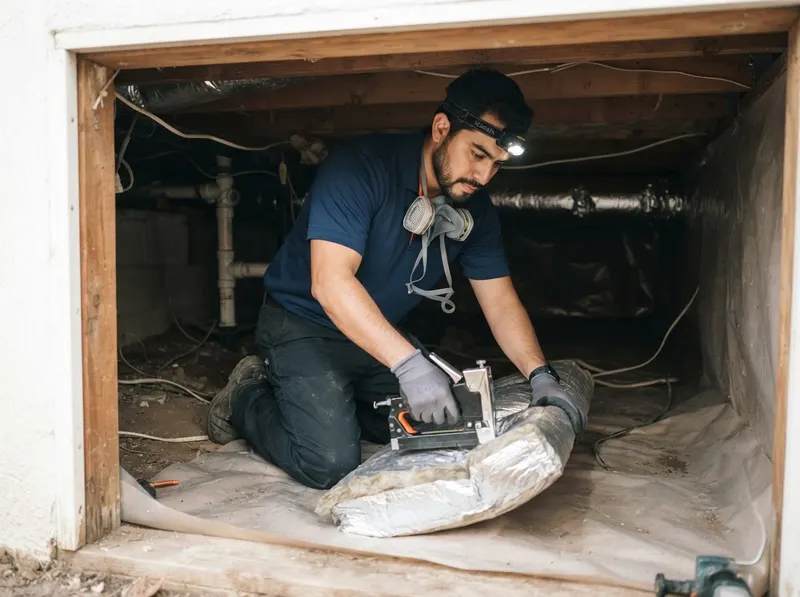
Crawlspace vapor and rodent restoration in San Diego neutralizes critical structural hazards caused by coastal fog cycles, canyon moisture, and persistent biological intrusions. In marine-layer corridors such as Ocean Beach, Pacific Beach, Point Loma, and La Jolla, ambient humidity routinely penetrates unconditioned subfloors, pooling on bare dirt. Concurrently, roof rats (Rattus rattus) and Norway rats (Rattus norvegicus) exploit subfloor vents and plumbing chases to establish nesting sites. This biological intrusion leads to contaminated crawlspace air carrying dried urine salts, airborne hantavirus fragments, and parasite feces directly upward into living spaces through the stack effect. Bravion Bug Solutions remediates these risks by systematically removing fouled fiberglass batts, HEPA-vacuuming droppings, treating structural floor joists with biocidal sanitizers, and sealing all entry points larger than 0.25 inches with galvanized 19-gauge wire mesh and polyurethane sealants.
Subfloor remediation differs significantly from basic rodent trapping. Surface trapping or consumer-grade bait stations only address active foragers without correcting the contaminated micro-environment underneath the structure. If a home exhibits localized rodent activity inside a single room, exterior perimeter exclusion and targeted interior capture suffice. However, when rodent urine and nesting material permeate crawlspace subflooring across homes in North Park, Hillcrest, or Clairemont Mesa, full environmental restoration is necessary. The trade-off is mechanical scope versus ongoing exposure: simple localized trapping carries lower upfront costs but leaves deteriorating insulation and contaminated fecal dust beneath the floorboards, whereas complete restoration requires clear subfloor clearance but permanently restores soil-to-subfloor biological integrity.
Soil grade and clearance across San Diego County dictate the restoration method. Canyon-side foundations in Scripps Ranch, Carmel Valley, and Mission Valley frequently feature variable foundation depths where damp soil sits directly against wooden framing. In these environments, technicians install minimum 10-mil reinforced cross-laminated polyethylene vapor retarders across 100% of the exposed earth, securing sheets with continuous stake pins and sealing overlapping seams by at least 12 inches using heavy-duty vapor tape. This halts soil vapor evaporation that rots subfloor timber while eliminating the damp shelter conditions that sustain rodent colonies. The resulting installation establishes an impenetrable ground moisture control layer and a sealed perimeter designed to protect the immediate home interior above.
Every job gets a firm, written price after a free on-site visit.
Tell us about your crawlspace vapor and rodent restoration job in San Diego and we'll send a clear, written quote, usually the same day.
 Bravion Bug Solutions