Argentine ant micro-bait vector control targets the specific biology of Linepithema humile, an invasive species that forms interconnected multi-queen supercolonies throughout coastal and inland San Diego County. Retail…
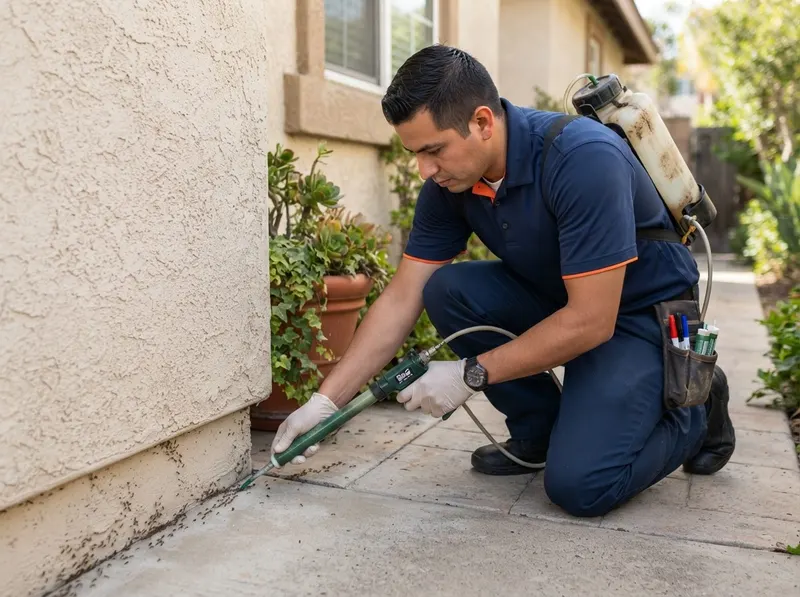
Argentine ant micro-bait vector control targets the specific biology of Linepithema humile, an invasive species that forms interconnected multi-queen supercolonies throughout coastal and inland San Diego County. Retail contact sprays and repellent barrier chemicals trigger an immediate survival reaction known as budding, causing a single supercolony to fraction into multiple reproductive satellite nests. Bravion Bug Solutions deploys microscopic liquid and granular bait matrices formulated with non-repellent delayed-action active ingredients. Foraging worker ants collect these vectors, carry them deep into subterranean subterranean nests, and feed them to reproductive queens and larvae via trophallaxis. A standard residential structural perimeter requires between 12 to 24 precision micro-bait stations placed at 10-foot intervals along verified pheromone highways, completely arresting the reproductive cycle across 100% of subterranean brood chambers within 14 to 21 days.
Local environmental pressures dictate exact bait matrix selection across San Diego microclimates. Along coastal canyons in La Jolla, Ocean Beach, and Point Loma, marine layer humidity and morning fog necessitate moisture-stable gel matrix formulations that resist fungal degradation. In drier inland mesa communities including Clairemont Mesa, Scripps Ranch, and Carmel Valley, high thermal evaporation demands liquid delivery systems protected inside UV-resistant bait reservoirs. Residential properties bordering open-space native vegetation near Mission Bay Park, Balboa Park, or Tecolote Canyon in Mission Valley experience severe dry-season invasions between July and October as ambient soil humidity drops below 15%. When landscape soil moisture declines, colonies transition their foraging vectors directly toward kitchen plumbing conduits, slab foundation expansion joints, and weep screeds in structures across North Park and Hillcrest.
Decision guidance dictates that structural micro-bait vectoring is required whenever an ant trail contains multiple active queens or exceeds 50 workers per linear foot near subfloor framing. While single-queen nuisance species like odorous house ants may yield to single-point localized treatments, Argentine ant supercolonies span across neighboring parcel lines, rendering superficial topical barriers counterproductive. The logistical trade-off involves eradication velocity versus biological depth: fast-acting synthetic pyrethroids kill surface foragers within 60 minutes but leave millions of subterranean queens intact, whereas professional micro-baiting preserves forager vitality for 48 to 72 hours specifically to maximize active ingredient transfer directly to the reproductive hierarchy.
Every job gets a firm, written price after a free on-site visit.
Tell us about your argentine ant micro-bait vector control job in San Diego and we'll send a clear, written quote, usually the same day.
 Bravion Bug Solutions